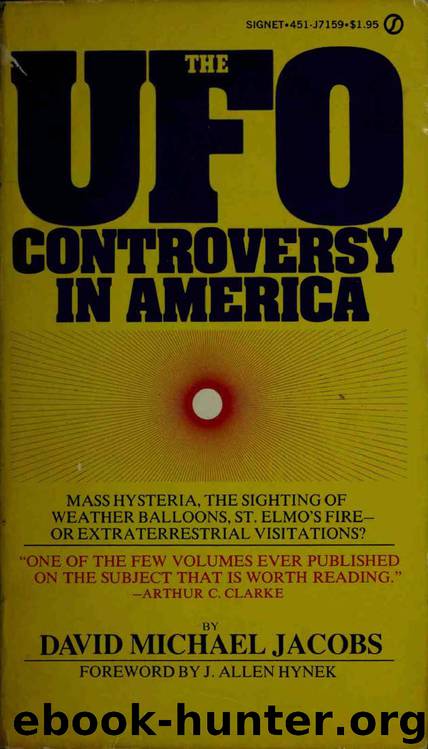
The UFO Controversy in America by David M. Jacobs
Author:David M. Jacobs [Jacobs, David M.]
Language: eng
Format: epub
Published: 0101-01-01T00:00:00+00:00
7. The Battle for Congressional Hearings
Congressional hearings presented a serious threat to the Air Force. They might imply that the UFO phenomenon was vitally significant and that the government was very interested in it. This might lead to another “flying saucer scare,” threatening to the national interest. Hearings might force the Air Force to declassify its files, contradicting Air Force claims that its files were open already. Hearings might prompt criticism of the Air Force’s UFO investigation, criticism that would harm its public relations program. Therefore, preventing or limiting congressional hearings became a major objective for the Air Force from 1957 to 1964.
Handling the hearings problem and congressional inquiries about the UFO program fell to the Secretary of the Air Force Office of Legislative Liaison (SAFLL). It continually assured congressmen that the Air Force’s UFO program was adequate to the task. Relying heavily on Special Report Number 14 for its information, SAFLL told New Jersey Congressman Frelinghuysen that there was a “total” lack of evidence to suggest that anything unusual was in the skies or that the objects were interplanetary vehicles. Writing to Representative Lee Metcalf (of Montana) in early 1957, Major General Joe Kelly of SAFLL defended the way in which the Air Force dealt with UFOs: its interceptors pursued UFOs “as a matter of security to this country and to determine aspects involved” and it kept the public informed and released summaries of evaluated UFO reports. “For those objects which are not explainable,” Kelly said in support of the classification policies, “only the fact that the reports are being analyzed is considered releasable due to the many unknowns involved.”[1]
Despite these assurances, some congressmen still considered holding public hearings on the subject. Under pressure from Keyhoe and NICAP, in January 1958 the Senate Subcommittee on Government Operations (Senator John McClellan, chairman) asked to meet with representatives from SAFLL to discuss the possibility of holding open hearings on the Air Force’s UFO program. At the meeting William Weitzen, deputy of the Air Force research and development operations, said the Air Force saw no reason for hearings but would cooperate if the McClellan subcommittee thought them necessary. The participants discussed the UFO program, the beneficial aspects of the hearings, and the potentially harmful effects of hearings. Whereas hearings might show that the Air Force was doing its job, the participants said, the “uncontrolled publicity” that might result could be dangerous.[2]
The outcome of the discussion was that Richard Homer (assistant secretary of the Air Force for research and development) told subcommittee chief counsel Donald O’Donnell that hearings were “not in the best interest of the Air Force.” O’Donnell, impressed with the Air Force’s UFO program after hearing about its work, said he would advise the subcommittee to drop the issue. In an unsigned February memorandum, an Air Force officer said it seemed as if “there is no longer any basis for congressional, press, or public criticism of Air Force UFO activities.” Because inquiries about UFOs drastically dropped after the launching of the
Download
This site does not store any files on its server. We only index and link to content provided by other sites. Please contact the content providers to delete copyright contents if any and email us, we'll remove relevant links or contents immediately.
| Ancient & Controversial Knowledge | Ghosts & Hauntings |
| Hermetism & Rosicrucianism | Magic Studies |
| Occultism | Parapsychology |
| Supernatural | UFOs |
| Unexplained Mysteries |
Animal Frequency by Melissa Alvarez(4474)
Sigil Witchery by Laura Tempest Zakroff(4247)
Real Magic by Dean Radin PhD(4129)
Fingerprints of the Gods by Graham Hancock(4005)
Aleister Crowley: The Biography by Tobias Churton(3640)
Journeys Out of the Body by Robert Monroe(3625)
Alchemy and Alchemists by C. J. S. Thompson(3522)
The Rosicrucians by Christopher McIntosh(3521)
Mysteries by Colin Wilson(3456)
Hitler's Monsters by Eric Kurlander(3343)
The Hatha Yoga Pradipika (Translated) by Svatmarama(3343)
Wicca: a guide for the solitary practitioner by Scott Cunningham(3179)
John Dee and the Empire of Angels by Jason Louv(3167)
Infinite Energy Technologies by Finley Eversole(2986)
Book of Life by Deborah Harkness(2939)
Dark Star Rising by Gary Lachman(2869)
The Book of Lies by Aleister Crowley(2847)
Aliens by Jim Al-Khalili(2830)
To Light a Sacred Flame by Silver RavenWolf(2824)
